
How many deck tiles do I need? Start with your floor area, add a planning allowance, then round up to complete packs of your chosen product. Use the deck tile calculator below to estimate both the tiles needed and the sets to order. Select the pack option that matches the product you intend to buy.
Deck tile calculator
Choose your VictoryRelax pack size and estimate how many complete sets to order.
Both pack sizes have the same listed tile dimensions: 12″ × 12″, with a height of 0.7″ for Square Joint or 0.9″ for Round Joint. Matching dimensions do not confirm compatibility between joint types.
Estimate only. Based on approximately 1 sq ft per tile. Confirm your assembled layout and cutting needs before ordering.
Explore VictoryRelax acacia deck tiles
-
Sale
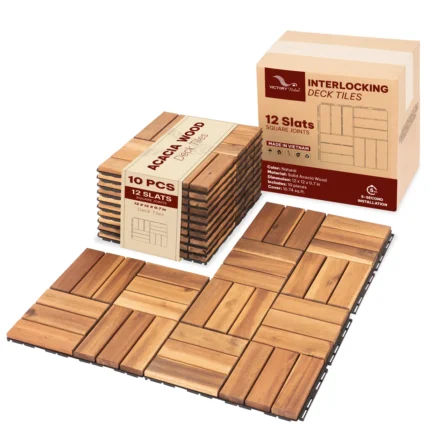
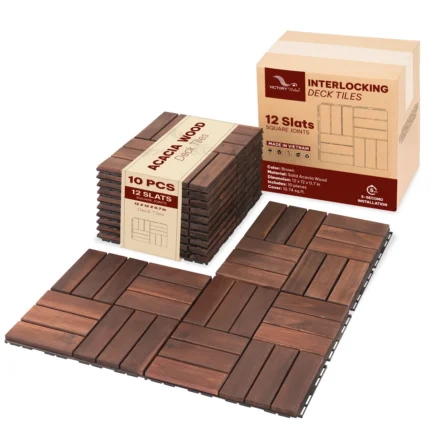
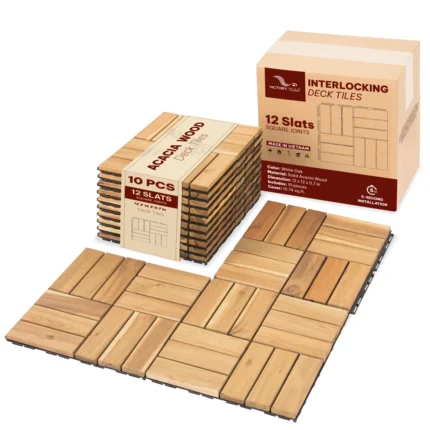
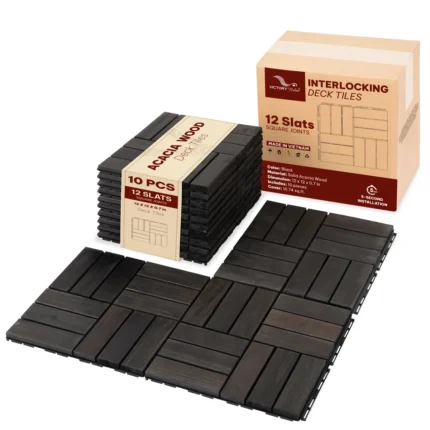 Decking Tiles
Wooden Deck Tiles Pack of 10 – 12 Slats, Square Joint
ColorNatureWalnutLight NatureBlack$43.99$59.3926% OffSale
-
Sale
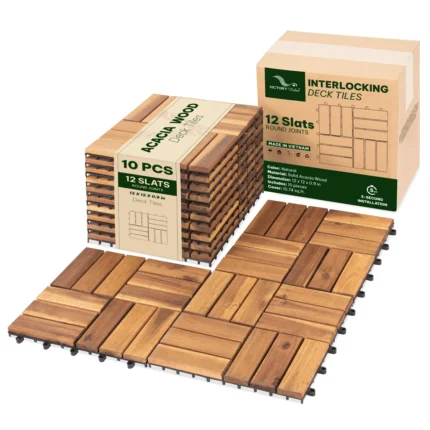
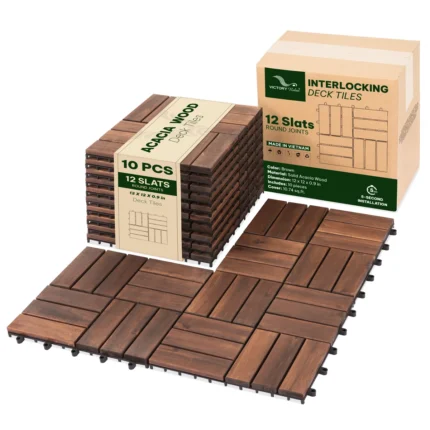
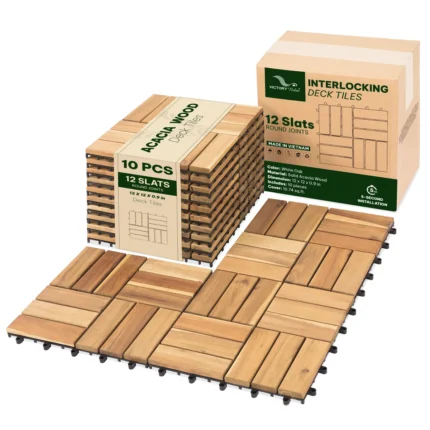
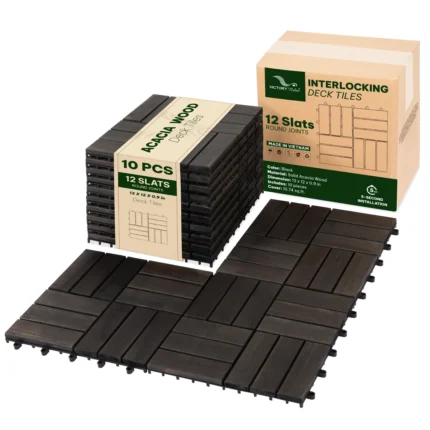 Decking Tiles
Wooden Deck Tiles Pack of 10 – 12 Slats, Round Joint
ColorNatureWalnutLight NatureBlack$29.99$40.4926% OffSale
-
Sale
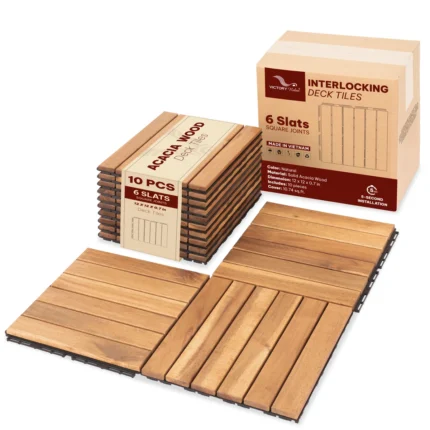
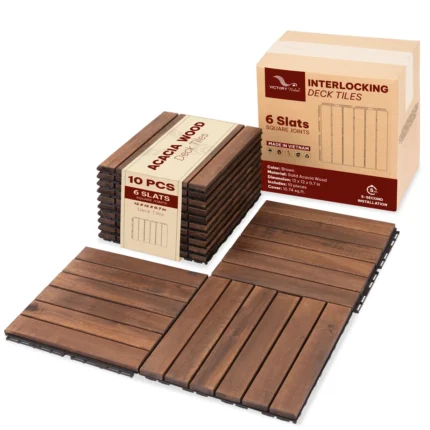
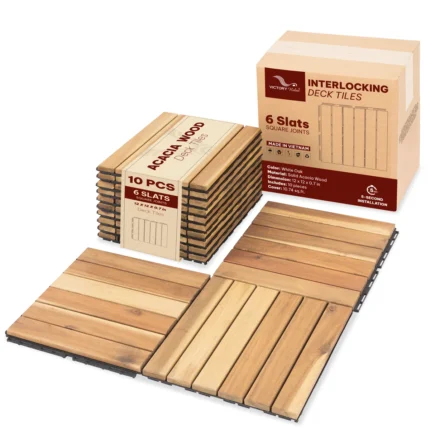
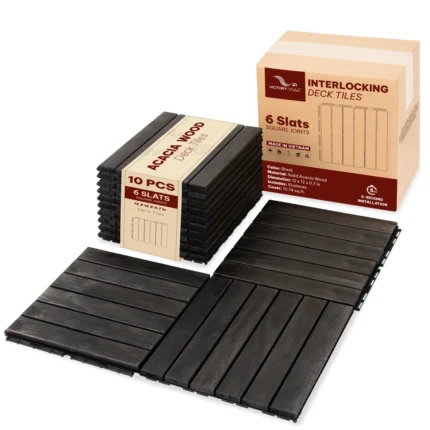 Decking Tiles
Wooden Deck Tiles Pack of 10 – 6 Slats, Square Joint
ColorNatureWalnutLight NatureBlack$34.99$47.2426% OffSale
-
Sale
 Decking Tiles
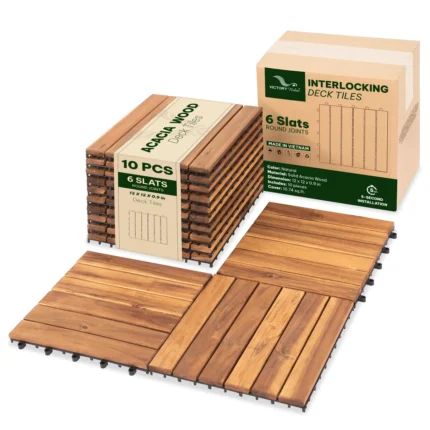
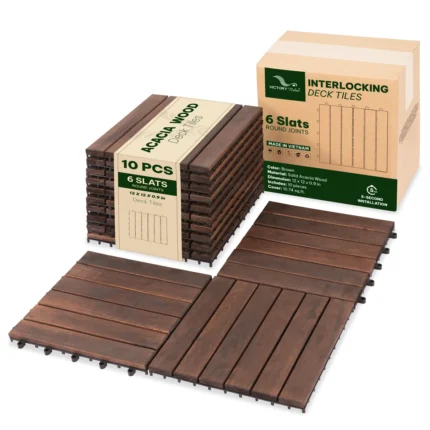
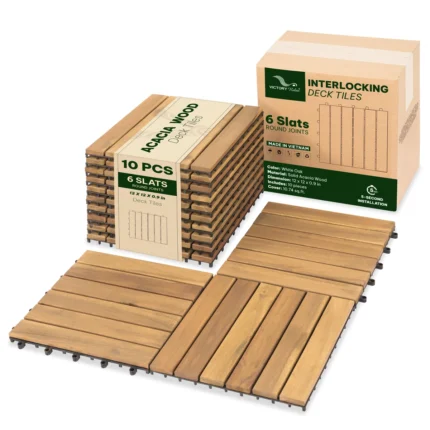
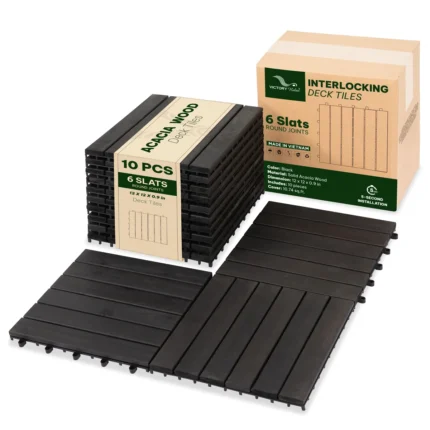
Wooden Deck Tiles Pack of 10 – 6 Slats, Round Joint
ColorNatureWalnutLight NatureBlack$29.99$40.4926% OffSale
-
Sale
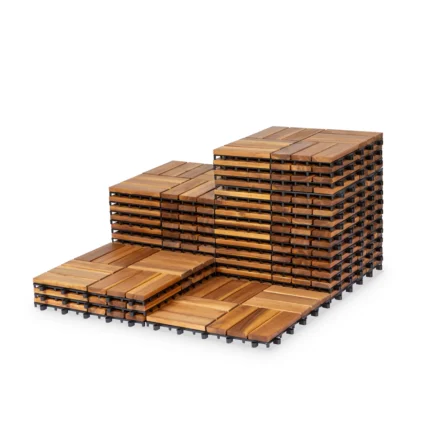
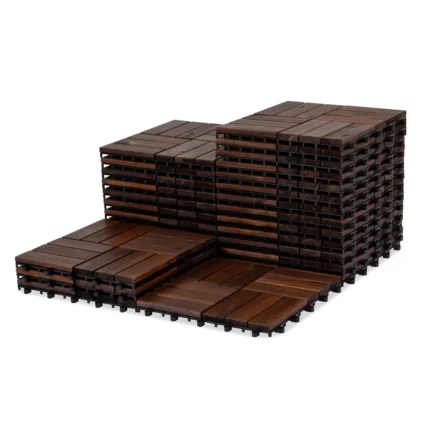 Decking Tiles
Round Joint Acacia Wood Deck Tiles, 12-Slat Interlocking Design for Indoor & Outdoor (Set of 27)
ColorNaturalBrown$77.05$104.0226% OffSale
-
Sale
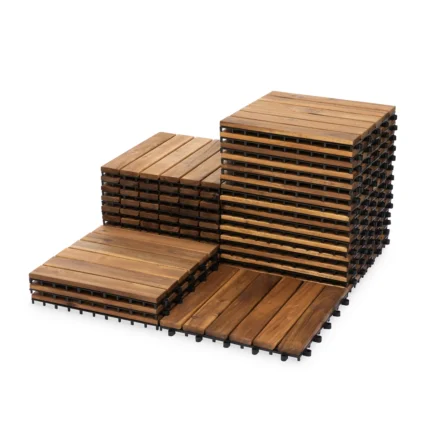
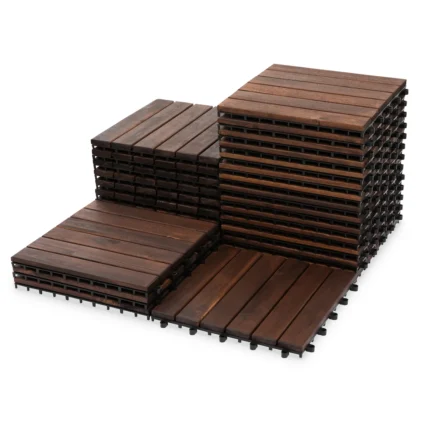 Decking Tiles
Round Joint Acacia Wood Deck Tiles, 6-Slat Interlocking Design for Indoor & Outdoor (Set of 27)
ColorNaturalBrown$77.05$104.0226% OffSale
The number of tiles needed for a floor and the number of packs to buy are different quantities. Changing the tiles per pack changes the number of complete packs and the tiles supplied. If coverage per tile stays the same, it does not change the floor’s estimated tile requirement.
How to Use the Deck Tile Calculator
- Select your pack: match the tiles per set and listed specifications to your chosen product.
- Enter length and width: measure the full footprint you intend to tile, including beneath movable furniture.
- Choose your unit: use feet or meters consistently for both dimensions.
- Choose a planning allowance: review cuts, corners and obstacles before deciding how much extra to allow.
- Read the order result: use “Sets to order” for the quantity of the selected pack to purchase.
Estimated tiles needed includes the selected allowance. Tiles supplied is the total supplied in complete packs. Tiles beyond estimate is the difference before actual cutting; it does not promise that those tiles will remain untouched after installation.
The calculator uses published approximate coverage for the options it offers. Check the selected pack’s coverage and specifications against the product listing before ordering. If your intended option is not available in the calculator, use its verified coverage and pack quantity with the formula below rather than selecting a different pack as a substitute.
Understand Tile Coverage and Pack Quantity
When comparing outdoor decking tiles, keep these details separate:
| Detail | What it tells you |
|---|---|
| Coverage per tile | The approximate floor area one tile covers for quantity planning. |
| Tiles per pack or set | The number of individual tiles supplied in one product unit. |
| Coverage per pack | The published approximate coverage of the complete pack. |
| Listed dimensions and height | Product measurements to review for layout, fitting and door clearance. |
| Surface pattern and connector type | Design and connection details; these are not the number of tiles supplied. |
If a listing provides pack coverage and tile quantity, divide that coverage by the number of tiles to obtain approximate coverage per tile. Use consistent area units. Do not assume every product covers the same area merely because it looks similar.
Slats are the wood strips on a tile’s surface, not separate tiles. A different slat pattern alone does not establish different coverage. Likewise, matching listed dimensions do not confirm connector compatibility. The deck tile buying guide can help when choosing deck tiles for your layout.
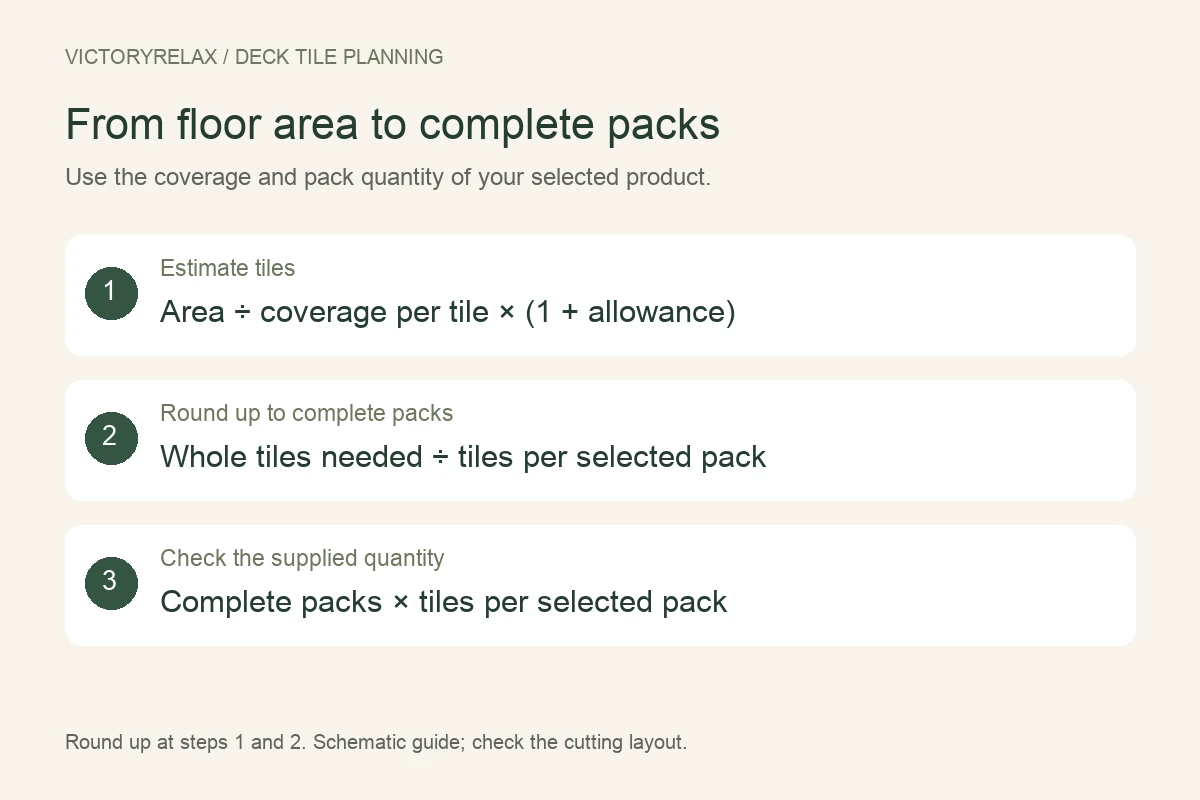
Calculate the tile requirement first, then use the selected pack quantity to round up to complete packs. Schematic guide.
Step 1: Measure the Floor You Want to Cover
For a rectangular balcony or patio, floor area = length × width. A floor measuring 6 ft × 8 ft has an area of 48 sq ft. These dimensions are an illustrative example, not a measurement of your floor.
Include the floor beneath chairs, tables and movable planters if you intend to tile underneath them. Subtract permanent areas only when they will remain untiled, and mark drainage access, thresholds and posts on your sketch.
For an L-shaped floor, divide the footprint into non-overlapping rectangles and add their areas. Apply your quantity calculation to the combined area before rounding to packs; rounding each section to a separate order can overstate the purchase quantity.
- Measure both sides in the same unit.
- Feet × feet gives square feet; meters × meters gives square meters.
- If measuring in inches, divide length × width by 144 to obtain square feet.
- Check narrow perimeter strips and obstacles separately from the area estimate.
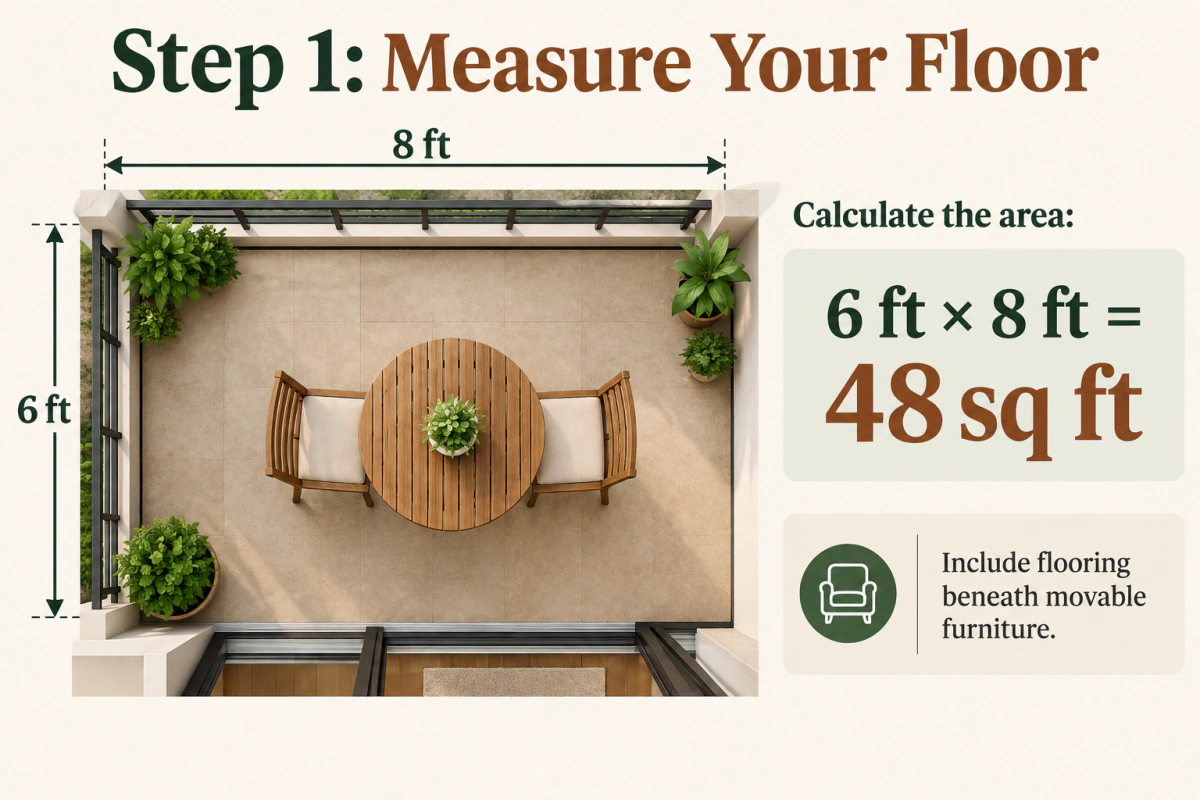
Illustrative floor area: 6 × 8 ft = 48 sq ft, including areas beneath furniture if you intend to tile them.
Step 2: Estimate Whole Tiles With an Allowance
Estimated tiles = round up [floor area ÷ approximate coverage per tile × (1 + allowance)]
Express the allowance as a decimal in the formula: an illustrative 5% becomes 0.05. Use the same area unit for the floor and the coverage per tile.
For an Estimated example, assume a 48 sq ft floor, approximate coverage of 1 sq ft per tile and an illustrative 5% allowance:
| Calculation | Estimated result |
|---|---|
| Floor area | 6 × 8 = 48 sq ft |
| Tile requirement before allowance | 48 ÷ 1 = 48 tiles |
| Apply the illustrative allowance | 48 × 1.05 = 50.4 tiles |
| Round up to whole tiles | 51 tiles |
This gives a tile estimate, not a fixed number of packs. The pack calculation comes next, using your chosen product’s tiles per pack.
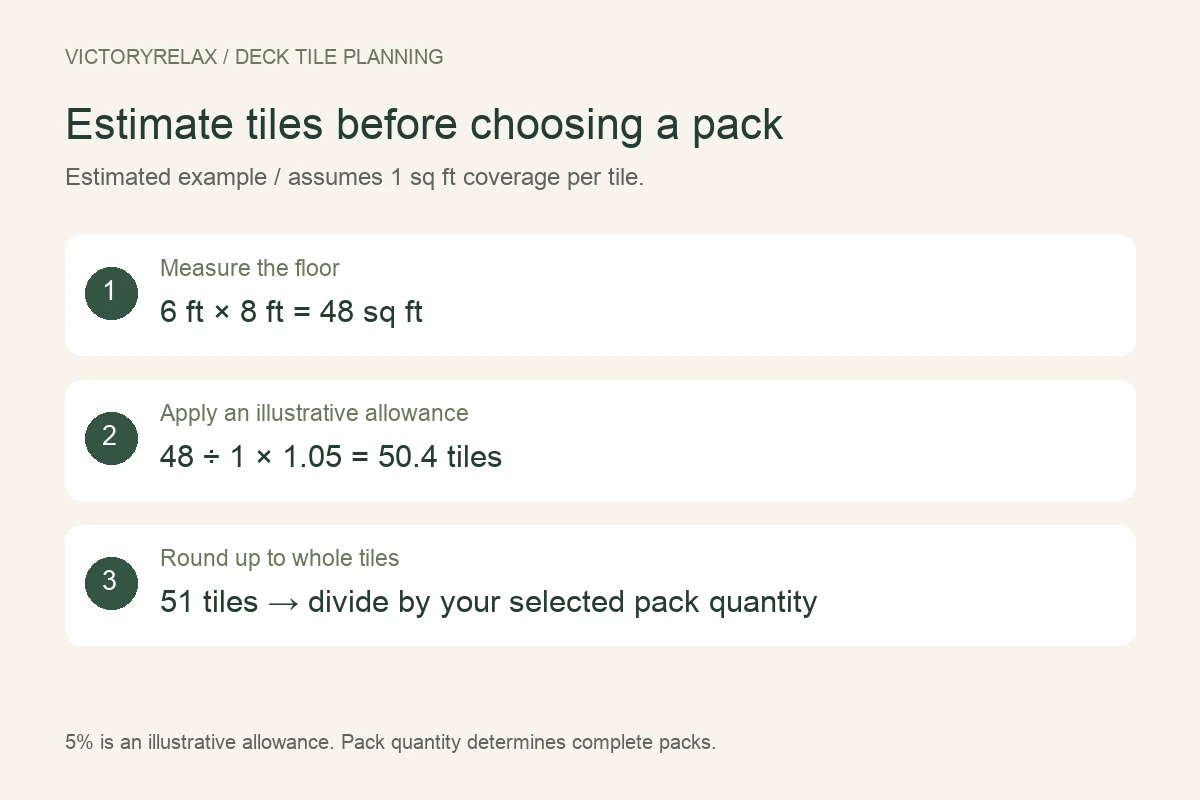
Estimated example: 48 sq ft at 1 sq ft per tile, plus an illustrative 5%, rounds up to 51 tiles. Complete packs depend on the selected pack quantity.
Step 3: Convert Tiles Into Complete Packs
Packs to order = round up [estimated whole tiles ÷ tiles per selected pack]
Tiles supplied = packs to order × tiles per selected pack
Use the pack quantity shown for the exact product you plan to order. A pack may also be described as a “set”; one unit in your cart should correspond to the selected product pack. Confirm that on the listing.
For the example above, divide 51 by your selected pack’s tile quantity and round up. Multiply the result by that same pack quantity to check the total tiles supplied. This method also works for another pack quantity without changing the formula.
Whole-pack rounding can provide tiles beyond the allowance-adjusted estimate. Check that supplied total before adding another pack. The calculator estimates one selected pack option at a time; it does not optimize a mixture of different pack sizes.
Quick Reference: Tile Estimates Before Pack Rounding
All quantities below are Estimated, using the illustrative assumptions of 1 sq ft per tile and a 5% allowance. They are not universal product coverage specifications. Divide the estimated tiles by your selected pack quantity, then round up to find complete packs.
| Illustrative floor area | Estimated whole tiles including 5% |
|---|---|
| 20 sq ft | 21 |
| 40 sq ft | 42 |
| 48 sq ft | 51 |
| 60 sq ft | 63 |
| 80 sq ft | 84 |
| 100 sq ft | 105 |
| 120 sq ft | 126 |
If coverage per tile differs from this example, recalculate using the selected product’s published coverage rather than using this table.
Plan your deck tile project
Check the Layout Before Ordering
Before deck tile installation, compare the quantity estimate with actual rows and edge cuts. Two floors with the same area may use different numbers of whole tiles because of their shape and the usefulness of offcuts.
- Sketch the boundaries: mark doors, thresholds, posts, drains and permanent untiled areas.
- Review perimeter rows: identify narrow strips, corners and where full tiles need cutting.
- Check offcuts: confirm their size, orientation and remaining connection points before relying on reuse.
- Confirm product specifications: check height and door clearance for the selected product, and verify the actual assembled dimensions for precise fitting.
- Keep the system consistent: confirm connector compatibility before mixing designs or packs.
An area estimate does not establish the assembled repeat distance or guarantee an exact fit. Review your layout and the selected product’s details before completing the order.
Frequently Asked Questions
Can this deck tile calculator tell me how many sets to order?
Yes. Choose the matching pack option, enter the floor dimensions and select an allowance. “Sets to order” rounds the tile estimate up to complete packs using the selected tiles per set. Check that this option matches the product in your cart.
Does choosing another pack size change how many tiles my floor needs?
If coverage per tile is unchanged, the estimated tile requirement stays the same. The number of packs and the supplied tile total can change because the calculator rounds to complete packs. If coverage per tile also changes, recalculate the tile estimate using that coverage.
Does the calculator work with measurements in meters?
Yes. Select Meters and enter both length and width in meters. The calculator converts the area for its coverage calculation. Do not enter square meters in a length or width field.
What if my pack option is not shown?
Use the product’s verified approximate coverage and tiles per pack with the formulas in this guide. Do not assume another listed option has matching specifications. Only use a calculator option that matches the intended product.
Can I calculate exact coverage from the listed tile dimensions?
Listed dimensions do not necessarily establish the assembled repeat distance. Use published approximate coverage for initial quantity estimates and confirm the actual assembled layout for precise fitting and edge cuts.
How many deck tiles do I need for a 100 sq ft patio?
As an Estimated example, at 1 sq ft per tile with an illustrative 5% allowance, you need 105 whole tiles before pack rounding. Divide 105 by the number of tiles in your selected pack and round up. Recalculate if your product’s coverage per tile differs.
Can I combine different pack sizes to reduce leftovers?
The calculator considers one pack option at a time. If you plan a combined order, verify that the tiles match in dimensions, connectors and design, then check the combined tile quantity against your estimate. A similar appearance alone does not confirm compatibility.
Measure the intended footprint, estimate tiles using the selected product’s coverage, then round up using its tiles per pack. Keep area, allowance, tiles needed and tiles supplied separate so you can check the order against the cutting layout.